Jokes Are Just Policy Nobody's Explained Yet: Ellen's Secret Weapon for Fixing Broken Politics
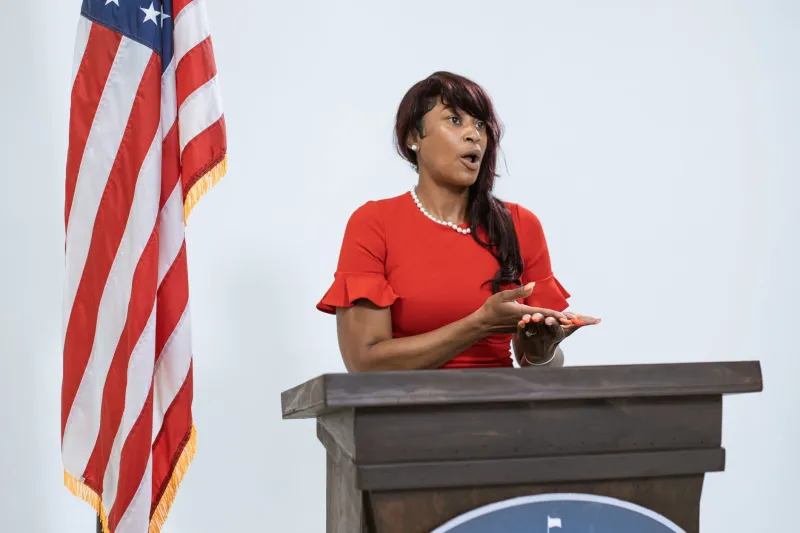
There's a moment that happens at almost every Ellen campaign event. She'll be mid-sentence about healthcare costs or student loan debt, and she'll slip in something — a callback, a deadpan aside, a perfectly timed pause — and the room cracks up. Then, before the laughter even fully settles, she's back on point, and somehow the policy actually landed. People get it. They remember it. They care about it in a way they didn't sixty seconds earlier.
That's not an accident. That's a skill set built over four decades in one of the hardest professions in the world: making strangers trust you enough to laugh.
And right now, trust is exactly what American politics is running out of.
The Trust Deficit Nobody Wants to Talk About
Poll after poll shows the same uncomfortable truth: most Americans don't believe the government is working for them. According to Pew Research, public trust in the federal government has hovered near historic lows for years, with fewer than two in ten Americans saying they trust Washington to do the right thing most of the time. That's not cynicism — that's a response to decades of politicians speaking at people rather than with them.
The language of politics has become its own kind of barrier. Talking points, buzzwords, carefully focus-grouped phrases that say a lot without actually communicating anything. People tune out. They feel talked down to, or worse, ignored entirely.
Ellen's entire career has been built on doing the opposite of that.
Whether she was doing stand-up in New Orleans clubs in the 1980s, navigating the cultural earthquake of coming out on national television in 1997, or spending nearly two decades on a daytime talk show that reached millions of households every single afternoon, she has always had one core skill: the ability to meet people exactly where they are.
Comedy as a Communication Technology
Here's something that doesn't get said enough in political circles — humor is actually a remarkably sophisticated communication tool. Neuroscience backs this up. When we laugh, our brains release dopamine and lower cortisol, the stress hormone. We become more open, more receptive, more willing to consider new ideas. A well-placed joke doesn't distract from a serious message; it creates the psychological conditions for that message to actually stick.
Ellen has been running this experiment at scale for decades without anyone calling it what it is: applied political communication.
Think about how she explained income inequality to a daytime audience during a segment about tipping culture, or how she used a bit about grocery store self-checkout to get into a real conversation about the dignity of labor. These weren't policy papers. They weren't congressional testimony. They were relatable observations that opened a door, and she walked viewers right through it.
That's the approach she's bringing to this campaign — and to the White House, if Americans give her the chance.
Breaking Down the Walls Between Policy and People
One of the biggest criticisms leveled at progressive policy ideas — Medicare for All, green energy investment, student debt relief — is that they're too complicated, too abstract, too disconnected from the kitchen-table reality of most American families. Ellen's answer to that isn't to dumb the policies down. It's to translate them.
At a town hall in Milwaukee last month, she talked about climate change not through the lens of carbon parts per million, but through the story of a local farmer who'd watched her family's crop yields drop over fifteen years. She was funny about it — she made a crack about how the only thing growing reliably in Washington was the size of oil company lobbying budgets — but the point was devastating and clear. People left that room understanding the stakes in a way a white paper never could have communicated.
That's the Ellen difference. She's not simplifying. She's humanizing.
The Relatability Factor in a Season of Distrust
There's another dimension to this worth exploring: authenticity. Voters in 2024 and beyond are extraordinarily good at detecting when a politician is performing relatability rather than actually having it. The forced "I love this diner" photo-op, the rehearsed laugh, the carefully scripted "real moment" — people clock it immediately, and it makes the trust problem worse, not better.
Ellen's humor has never felt manufactured because it isn't. It comes from the same place her policy instincts come from: a genuine curiosity about people, a deep discomfort with pretension, and a lifetime of having to read rooms and respond honestly to what she found there.
She grew up without a lot of money. She built her career from nothing in a business that chews people up. She came out publicly at a time when it genuinely cost her something. These aren't talking points — they're the source material for a communication style that feels real because it is real.
When Ellen makes a joke about the absurdity of the American health insurance system, it doesn't sound like a politician pretending to understand frustration. It sounds like someone who has actually sat on hold with an insurance company for forty-five minutes arguing about a claim. Because she has.
What This Looks Like in the Oval Office
Skeptics sometimes ask whether a comedian can be taken seriously on the world stage. It's a fair question, and Ellen has a pretty direct answer: the world stage isn't actually that different from any other stage. Every effective leader — every person who has ever successfully moved a group of people toward a shared goal — has had to communicate across difference, build trust quickly, and make complex ideas feel accessible.
Ellen's vision for her administration isn't a comedy show. It's a government that actually talks to people like adults who deserve honesty, clarity, and yes, occasionally, a laugh. Town halls that feel like conversations instead of performances. Press briefings that answer questions instead of dodging them. A president who can sit across from a skeptical voter in Ohio or a nervous small business owner in Arizona and make them feel genuinely heard.
She's also been clear that the humor has limits — and she knows where those limits are. When she talks about gun violence, she's not cracking jokes. When she talks to grieving families or communities dealing with economic devastation, she shows up with the same empathy that made her a household name, without the punchlines. The skill isn't just knowing how to be funny. It's knowing when not to be.
The Bigger Picture
America doesn't just need better policies right now — although it does need those too, and Ellen has them. It needs a different relationship with its own government. It needs to feel like Washington is a place where real people's real problems actually get addressed, not just acknowledged in a speech and forgotten by the next news cycle.
Rebuilding that relationship requires someone who knows how to build relationships. Someone who has spent a lifetime figuring out how to connect with people who are skeptical, distracted, or just plain exhausted by the noise.
Ellen DeGeneres has been doing exactly that since before most of the current field of candidates ever thought about running for anything.
The late-night policy sessions are coming. And if Ellen has her way, they're going to be a lot more engaging than anything Washington has seen in a very long time.